
Finance Sector Roadmap
This Roadmap recommends the key steps needed for financial institutions to eliminate commodity-driven deforestation, conversion, and associated human rights abuses from their portfolio.
How to tackle commodity-driven deforestation in your portfolio: a step by step roadmap
Focused specifically on deforestation, conversion, and associated human rights risks, this Roadmap is applicable to all financial institutions. It provides high-level guidance along a clear timeline for action to enable financial institutions to contribute to tackling deforestation, conversion, and associated human rights abuses and to eliminate them from their portfolios within four years of beginning the Roadmap.
The Roadmap also includes information specific to Brazil’s cattle sector displayed alongside the Roadmap’s broader recommendations.
The Roadmap is divided into five phases, plus a section on how to go beyond zero deforestation towards a nature- and people-positive approach. All phases are available in English and Portuguese.
Click a box below to enter the interactive Roadmap, starting with Phase 1. There is a menu at the top and bottom of each page to easily navigate between the different Phases.
The Roadmap
Going above and beyond: Nature and people positive Going above and beyond
Eliminating commodity-driven deforestation
Financial portfolios can be exposed to commodity-driven deforestation risk through their financing activities in two key ways:
- financing clients/holdings (direct finance recipients) which are directly connected to deforestation risk through the production or processing of forest-risk commodities
- financing clients/holdings (direct finance recipients) which procure forest-risk products, or those that finance these activities and commodities.
The finance sector is critical in driving change towards a deforestation-, conversion-, and human rights abuse-free economy, and doing so at pace. There is an urgent need for financial institutions to set ambitious targets, engage with their clients/holdings which are exposed to deforestation risk, and to collaborate with other organisations to drive change across the finance sector.
This Roadmap recommends the key steps needed for financial institutions to eliminate commodity-driven deforestation, conversion, and associated human rights abuses from their portfolio within timebound target dates.
The Finance Sector Roadmap offers a pathway for financial institutions to understand, identify and address deforestation risk in their commodity supply chains, and make progress towards a future where forest-risk commodities do not drive deforestation, conversion, or associated human rights abuses.
This Roadmap is applicable to all financial institutions (e.g. banks, asset managers, insurers). Initially launched at COP26 in November 2021, it provides high-level guidance along a clear timeline for action to enable financial institutions to contribute to tackling deforestation, conversion, and associated human rights abuses and to eliminate them from their portfolios within four years of adopting the Roadmap.
The November 2025 updates to the Roteiro build on the Roadmap to customise this guidance for financial institutions exposed to the Brazilian cattle supply chain. These were launched in connection with COP30 – a summit that placed deforestation at the centre of the climate agenda.
As the biggest driver of deforestation and conversion globally, cattle is the single most influential commodity to move the needle on deforestation and linked greenhouse gas emissions. Brazil accounts for nearly 60% of global pasture-driven deforestation, and within the country, the cattle supply chain, combined with agriculture (such as soy production), is responsible for up to 97% of deforestation and land conversion. Yet eight in 10 (83%) of the companies with the greatest influence on these supply chains are yet to publish deforestation commitments for at least one of the cattle commodities relevant to them (they were assessed based on links to Brazilian beef and leather).
Over the past four decades, Brazil has lost an area of native vegetation comparable to the combined size of the United Kingdom, France and Italy. Pasture areas have increased by almost 60% over the same period.
This loss of critical forests and ecosystems releases greenhouse gas emissions into the atmosphere, while clearing forests removes vast carbon stores preventing the continued absorption of carbon dioxide. As a result, deforestation accounts for approximately half of Brazil’s greenhouse gas emissions. For Brazil, and its financial institutions, to meet commitments to global targets like the UN declaration to halt and reverse deforestation by 2030 and reach net zero greenhouse gas emissions by 2050, cattle-linked deforestation must urgently be addressed.
In 2024 the Brazilian Amazon experienced its worst drought on record. Floods in the south of the country, where large areas of natural ecosystems have been converted to agriculture and pastures, left thousands of people displaced. Companies and their profits were also put at risk, with reduced crop yields already being seen; drought and fires lowered Brazil’s agribusiness GDP in 2024; third-quarter decline exceeded expectations, and agribusiness GDP fell by 0.8% in the third quarter.
Brazilian cattle supply chains are highly complex, and deforestation, conversion and associated human rights risks can be hidden through indirect suppliers. Gaps in traceability allow cattle from illegally deforested areas to be ‘laundered’ through indirect suppliers, making it difficult to track their origin and identify human rights or environmental risks. Before reaching the slaughterhouse, cattle may pass through up to three types of farms: breeding, rearing/growing, and fattening. More information on cattle laundering is present in Phase 1.
This can lead to a low level of visibility across cattle supply chains, with many slaughterhouses having medium or low visibility across the breeding or growing stages of the supply chain for Brazilian cattle. This makes deforestation risks within these supply chains difficult to identify and manage, and they will continue to persist and intensify unless all companies take proactive measures. Fortunately, there are tools and strategies available to help companies address this issue and improve supply chain visibility, ensuring transparency across all suppliers. Financial institutions, in particular, play a critical role in driving corporate change within the Brazilian cattle supply chains through the implementation of effective policies, monitoring, and engagement.
Deforestation in Brazil’s cattle sector is a major challenge that requires coordinated and collaborative action from diverse stakeholders. Simply shifting sourcing regions does not reduce the exposure of companies or their financiers to risks unless deforestation itself is halted – engagement with high risk companies to address the sustainability of their practices is needed. Without such collaboration, the physical and economic risks will only escalate, as we are already seeing deforestation shift from critical ecosystems like the Amazon to other regions, such as the Cerrado, and consequences that extend beyond Brazil’s borders, with deforestation leakage on Paraguay and Bolivia. The financial risks associated with deforestation and ecosystem conversion continue to grow and it is not an isolated risk.
Governments are sending some promising messages on decoupling productive activity from deforestation. The Rio de Janeiro G20 Leaders’ Declaration emphasised the importance of halting and reversing deforestation and forest degradation by 2030, alongside a commitment to mobilising financing for forests through innovative mechanisms like the Tropical Forest Forever Fund. Brazil’s federal environmental protection agency IBAMA recently imposed fines of R$364 million (US$64 million) on cattle ranches and meat packers for raising or buying cattle on illegally deforested land in the Amazon. The Government of Pará (the state hosting COP30 in 2025) has set the goals of tracing 100% of its herd by 2026 and recovering 20% of degraded pastures.
Other states have adopted alternative strategies to advance traceability and local sustainability. One example is Mato Grosso’s Produce, Conserve, and Include (PCI) jurisdictional approach, which integrates public policies, public-private collaboration, and monitoring mechanisms to prevent deforestation leakage within a jurisdiction. By bringing together multiple stakeholders, the initiative seeks to ensure that all producers are included, fostering widespread participation in sustainable supply chain efforts.
This exemplifies how Brazil can be a leader on ending deforestation. In recent years, the federal government has taken decisive action to enforce regulation and protect human rights, leading to deforestation falling to its lowest levels since 2016. While global deforestation continues to rise, Brazil’s recent progress shows that change is possible with political will and coordinated action.
This momentum presents a clear opportunity. After a year of delay, the European Union Deforestation-Free Regulation (EUDR) is set to take effect at the end of 2025. While its impact may vary across different sectors, it has the potential to shift market expectations—especially when combined with growing demand from China for deforestation and conversion-free beef.
These developments reflect a growing geopolitical and legal recognition that protecting nature and achieving zero deforestation is not only an environmental imperative but also a strategy to secure long-term economic stability. Such regulations are vital to supporting financial institutions in reducing and addressing their deforestation exposure. Any disruption to these mechanisms would introduce greater risks and uncertainties as well as generating reputational, compliance and financial risks for financial institutions.
Financial institutions have a fiduciary duty to assess and manage the financial risks linked to deforestation. The depletion of natural capital caused by deforestation carries significant financial consequences for various economic activities, influencing asset values, increasing operational costs, and undermining market stability. Therefore, tackling deforestation is not only an environmental obligation but also a strategic necessity for maintaining financial resilience and ensuring long-term profitability. At the same time, financial institutions that fund high-risk companies have a unique opportunity to drive positive change. By influencing corporate behavior, they can play a key role in achieving climate net zero targets, protecting natural ecosystems, and positioning Brazil as a global leader in forest and biodiversity preservation. Proactively managing these risks strengthens both environmental and financial outcomes, aligning business interests with broader sustainability goals.
There is an opportunity for significant improvement to be made by the overwhelming majority of companies with the most influence over Brazilian cattle supply chains to effectively respond to the risk and impacts of deforestation, conversion, and associated human rights abuses, with positive signals of support from both national and state governments. Financial institutions too can improve, working to develop due diligence policies and portfolio screening processes, aligned with best practice. This includes extending beyond regional and national regulation alone, but stepping in line with international best practice of no deforestation and ecosystem conversion regardless of legality.
Brazil has brought a pioneering vision for the transition to sustainable ‘bioeconomies’ to the G20 and other fora. With some of the highest stakes and most relevant experience in addressing deforestation, Brazil and its financial institutions can shape the global conversation on sustainable business, finance and livelihoods for the better.
The Finance Sector Roadmap now also includes a set of additional, modular guidance in Phase 1 and Phase 2 specifically designed for financial institutions investing in the Brazilian cattle supply chain, either directly or indirectly. This includes all types of financial institutions, from banks to insurers, and those headquartered in Brazil or internationally. It offers additional information and guidance for financial institutions to understand, identify and address deforestation risk in their Brazilian cattle supply chains. Global Canopy intends to provide such additional guidance in Phase 3, Phase 4 and Phase 5 by the end of 2025.
How to use this Roadmap
The Roadmap is structured in five phases:
- Understanding and mapping risk
- Setting an effective policy and managing risk
- Monitoring and engagement
- Disclosing
- Eliminating deforestation
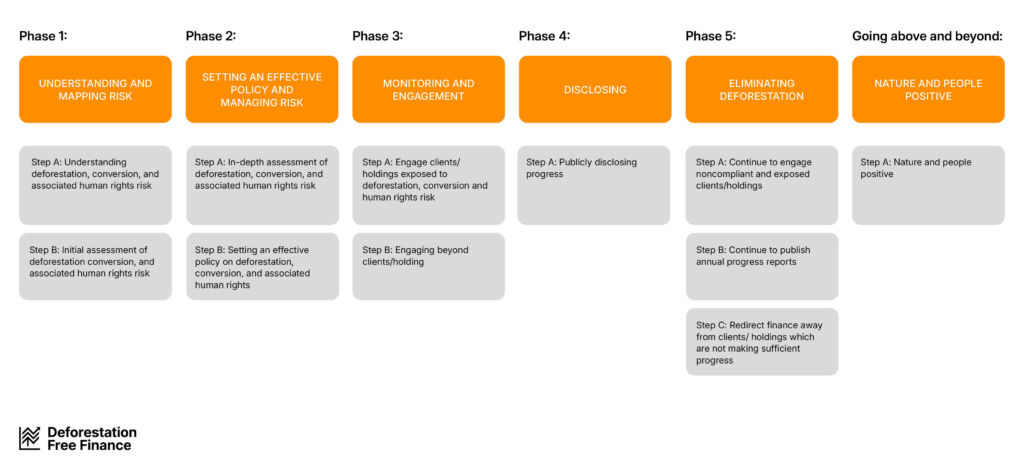
Each phase has one or two ‘steps’, broken down into specific ‘recommended actions’. This includes a set of additional guidance in Phase 1 and Phase 2 specifically designed for financial institutions investing in the Brazilian cattle supply chain, either directly or indirectly. These are highlighted in orange on the diagram above. Global Canopy intends to provide such additional guidance in Phase 3 , Phase 4 and Phase 5 by the end of 2025.
The Brazilian guidance was developed by Global Canopy in consultation with a working group of Brazilian-based civil society organisations and financial institutions, building off the Finance Sector Roadmap published in 2021 by the Finance and Deforestation Advisory Group.
These steps are not necessarily linear, and can be completed in any order within the phase. However, each of these steps are critical pieces of the process and should be addressed to ensure that commodity-driven deforestation, conversion, and associated human rights abuses are being eliminated from portfolios.
To support global goals and targets and achieve portfolios that are free from commodity-driven deforestation, conversion, and associated human rights abuses, all steps and recommended actions included in this Roadmap should be complete within four years or as soon as possible from starting on this Roadmap, or by 2025 by financial institutions that adopted the Roadmap at its launch in 2021.
If your organisation is already acting on deforestation, conversion, and associated human rights risks, identify where your organisation is currently operating within the phases outlined in this Roadmap, and then pick up from there following the objective time-period recommendations outlined in each phase.
Beyond the Roadmap’s primary focus on risk reduction, the Roadmap also highlights additional actions that financial institutions can take to redirect financing towards nature- and people-positive financing.
This Roadmap unites existing guidance – including the best practice for companies operating in forest-risk commodity supply chains as defined by the Accountability Framework initiative – and recommended datasets and tools in one place. It highlights at which point in the process each piece of guidance and data is most relevant.

